Wanna Play?

Photo Willem Popelier.

Photo Willem Popelier.

Photo Willem Popelier.

Photo Willem Popelier.

Photo Willem Popelier.

Photo Willem Popelier.

Photo Willem Popelier.

Photo Willem Popelier.

Photo Willem Popelier.
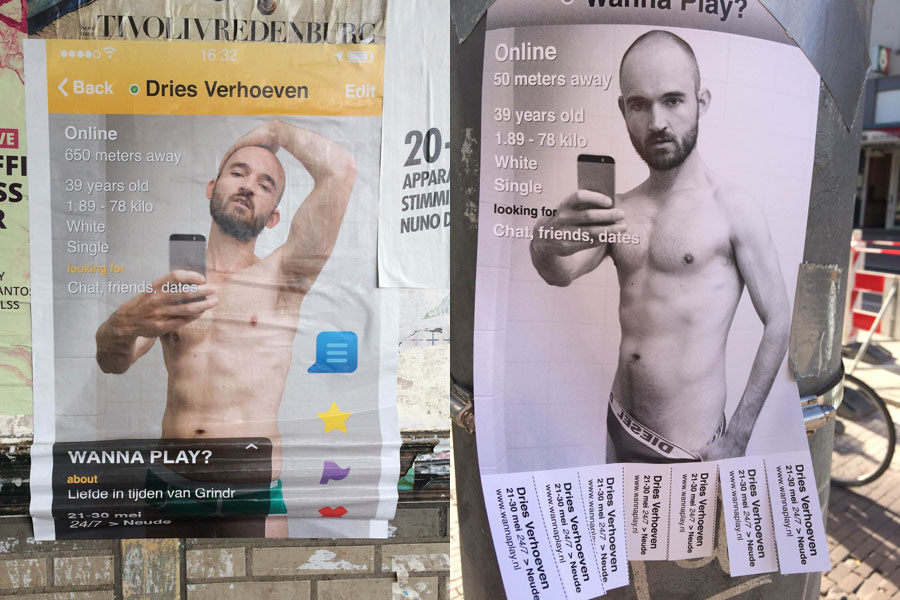
In Wanna Play? (Love in the time of Grindr) Verhoeven questions the changing nature of love and the influence of the smartphone on life in the public domain.
From a glass room placed in city centers, Verhoeven interacts with users of online dating apps like Grindr and Tinder about the nature of intimacy in our era, and asks them to visit him to satisfy his non-sexual desires. He proposes, for example, to wash their hair, to sing together in the shower, or to hold hands for an hour. Verhoeven’s life and search for connection is visible to everyone for 10 days, 24/7. The new public space, the internet, is made visible in the analogue public domain, the street. Digital becomes material. The screen of Verhoevens phone is constantly projected on a large screen; the chats can be read by everyone, but have been made anonymous: you cannot identify the person chatting with him.
With the emergence of dating apps such as Grindr and Tinder, a new revolution is underway: a date is available ‘on demand’. If we know how to sell ourselves, with the right slogan and right selfie, we have access to an endless supply of available men and women. Are we allowing the apps to seduce us into consuming each other’s attention and sexual potential or do they simply enable us to connect with each other much faster, while retaining the level of interaction?
One of the consequences of the phenomenon is the gradual disappearance of the Queer Village, places where homosexuals have been meeting since the 70s, and which as a result revealed deviating sexual preferences in the hetero-normative public space. For many homosexuals, the dating apps are becoming the most obvious meeting place. The ‘sexual deviant’, the ‘other’, has a distinct place in the online world. Does this also mean ‘queerness’ will be less visible on the street of the future?
For a ten-day period, Verhoeven goes in search of answers together with the people he meets. His findings are posted daily on a public blog, simultaneously providing the archive and contextualization of the work.
In Wanna Play? (Love in the time of Grindr) Verhoeven questions the changing nature of love and the influence of the smartphone on life in the public domain.
From a glass room placed in city centers, Verhoeven interacts with users of online dating apps like Grindr and Tinder about the nature of intimacy in our era, and asks them to visit him to satisfy his non-sexual desires. He proposes, for example, to wash their hair, to sing together in the shower, or to hold hands for an hour. Verhoeven’s life and search for connection is visible to everyone for 10 days, 24/7. The new public space, the internet, is made visible in the analogue public domain, the street. Digital becomes material. The screen of Verhoevens phone is constantly projected on a large screen; the chats can be read by everyone, but have been made anonymous: you cannot identify the person chatting with him.
With the emergence of dating apps such as Grindr and Tinder, a new revolution is underway: a date is available ‘on demand’. If we know how to sell ourselves, with the right slogan and right selfie, we have access to an endless supply of available men and women. Are we allowing the apps to seduce us into consuming each other’s attention and sexual potential or do they simply enable us to connect with each other much faster, while retaining the level of interaction?
One of the consequences of the phenomenon is the gradual disappearance of the Queer Village, places where homosexuals have been meeting since the 70s, and which as a result revealed deviating sexual preferences in the hetero-normative public space. For many homosexuals, the dating apps are becoming the most obvious meeting place. The ‘sexual deviant’, the ‘other’, has a distinct place in the online world. Does this also mean ‘queerness’ will be less visible on the street of the future?
For a ten-day period, Verhoeven goes in search of answers together with the people he meets. His findings are posted daily on a public blog, simultaneously providing the archive and contextualization of the work.
Video
Video by Thorsten Alofs.
Press
"I am always looking for possibilities to break through conventional thinking."
Two years after 'Wanna Play?' had to be stopped prematurely, Dries reflects on his experiences in an interview with Berlin-based LGBT magazine Siegessäule (5 November 2016)Read the article (in German)
"The intimate and open discussions this… creates give the public a view into the complexity of the homosexual world, which has been a closed stronghold for many people until now."
‘Een spannende paradox’ ('An exciting paradox'), Anouk Leeuwerink for Theaterkrant.nl (29 May 2015)Read the review (in Dutch)
"I notice I am more candid in the demarcated reality than towards my friends. Weird."
‘Wel intimiteit, geen seks’ ('Intimacy yes, sex no'), Hein Janssen voor De Volkskrant (28 May 2015)Read the report (in Dutch)
"It's fine that apps like Grindr exist, but they also form a carousel of continual self-affirmation."
‘Is er iemand die met me wil spelen?’ ('Does anyone want to play with me?'), Hein Janssen voor De Volkskrant (28 May 2015)Read the interview (in Dutch)
"Depth disappears when it seems someone is about to fulfil my horniest porn fantasies."
‘Wanna play? Wanna fun?’, Kim Bos for NRC Next (21 May 2015)Read the article (in Dutch)
"Verhoeven’s performance installations in particular, like Ceci n’est pas and now also Wanna Play?, cause a commotion and bring major contemporary themes to attention of a wide audience."
‘Daten vanuit een glazen huis’ ('Dating from a glass house'), Moos van den Broek for Theaterkrant.nl (1 October 2014)Read the review (in Dutch)
Background and public reception
own experience
Leading up to Wanna Play?, Verhoeven wrote a piece about his own experiences with the medium of Grindr and his starting point for the project.
radio
Verhoeven spoke to Botte Jellema about Wanna Play? for the VPRO Radio 1 programme Nooit meer slapen.
Listen to the broadcast (in Dutch)
Internet, the new public space?
The German/French tv network ARTE created a webseries on virtual love. Director Laure Michel spoke with Verhoeven about the implications of Cyberlove for our personal lives.
Watch the series (in German and French)
Prior to Wanna play? in Utrecht, Verhoeven hang ‘sexy selfie pictures’ of himself in the city centre.
controversy
The version of Wanna Play? in Berlin led to an outcry, the project had to be stopped prematurely. Below follow a number of articles about the event and the discussion it evoked.
For NRC Handelsblad Daan van Lent wrote an article about the course of events prior to the premature stopping of Wanna Play?, ‘Naiëf over homoseks chat-kunst’ (‘Naive about gaysex chat-art’).
Read the article (in Dutch)
In this text, Verhoeven himself reflects on prematurely stopping Wanna Play?.
“Liebe in Zeiten von Grindr? Man begegnet der Suche nach ihr mit so viel Hass, dass man weiter bohren will”. Kevin Junk commented on Wanna Play? with his article ‘„Wanna Play?“ – Liebe in Zeiten von Grindr. Ein Kommentar’ on wolfauftausendplateaus.de.
Read the comments (in German)
“Zurück in den Schrank?”, Siegessäule interviewed Dries after prematurely stopping Wanna Play? (November 2014).
Read the article (in German)
For the Argentinian newspaper Pagina 12 Lola Arias interviewed Verhoeven and wrote the article ‘El Amor en los tiempos virtuales’.
Read the interview (in Spanish)
compilation Berlin
Below is a video compilation of the project in Berlin, showing the outcry on the street.
Credits
concept Dries Verhoeven
production Studio Dries Verhoeven, Saskia Schoenmaker (2015) and Janne Callsen (2014)
technician Roel Evenhuis and Matthias Schäfer (2014)
projection chats Sylvain Vriens
photography Sascha Weidner (2014) en Willem Popelier (2015)
dramaturgy Cornelius Puschke (2014)
public conversation Esmee Dorenbos, Daphne Gakes, Ghislaine Huizinga, Lenne Koning, Reshma Jagernath, Harmen van Twillert, Sietske de Vries and Bart van de Woestijne